The dance
Buyō explained: the dance inside kabuki, and what to watch for
What Japanese dance is, how it split from the kabuki stage, and the three kinds of movement worth watching for in a temple recital.
Reserve a place ↗Quick answer
Buyō means dance, and nihon-buyō is the classical dance that grew out of kabuki during the Edo period. In its narrowest sense it is kabuki-buyō, the dance pieces performed on the kabuki stage. Wikipedia names three building blocks: mai, odori and furi. If you know those three words, you can follow almost any recital.
Buyō at a glance
| What the sources say | |
|---|---|
| Meaning | Japanese dance; the term nihon-buyō dates to the Meiji period |
| Origin | Developed in the Edo period through kabuki dances |
| Three elements | Mai, odori and furi |
| Two role styles | Onnagata (female roles) and tachiyaku (male roles) |
| Who dances | Men and women; a woman can dance a male role |
| Status | Kabuki-buyō listed as an important intangible cultural property since 1955 |
A name that is newer than the art
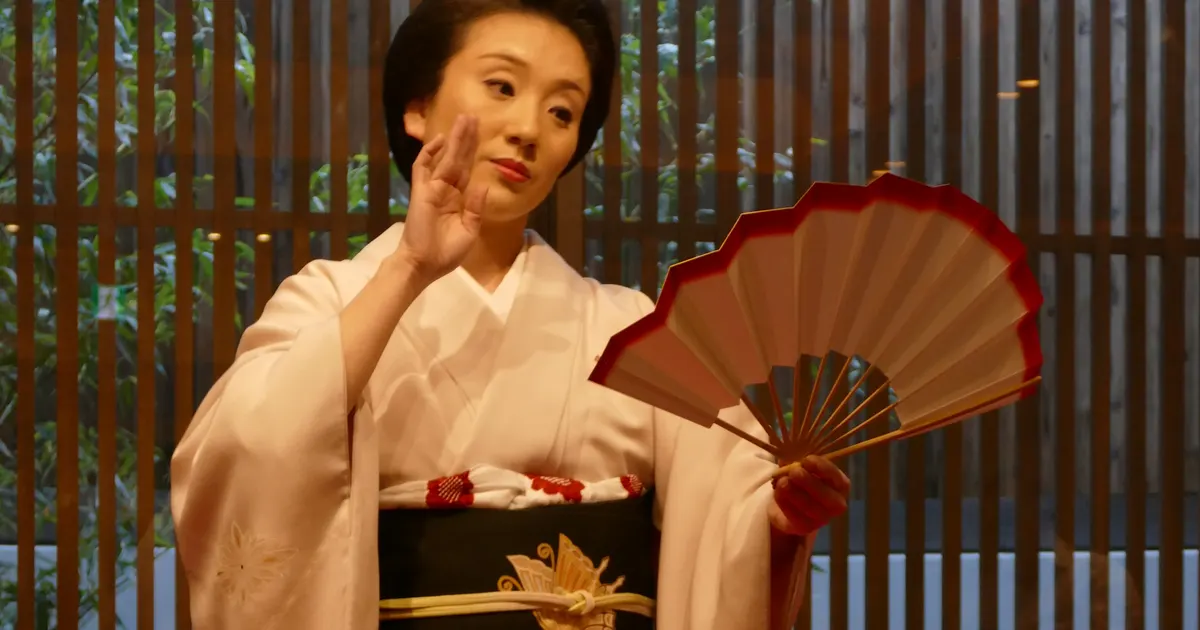
The word buyō is modern. Wikipedia says it was coined during the Meiji period, 1868 to 1911, as a term for dance, and that the writer Tsubouchi Shōyō is believed to have been the first to use nihon-buyō. Before that, the pieces went by names such as shosagoto, keigoto, furigoto or simply odori. The new term was meant for a kind of dance drama in kabuki, and it has since grown to cover several dance styles. The article is open about the fact that the field is hard to define, since it borrows from many traditions and has many schools.
The three kinds of movement
The most useful idea for a visitor is the trio of mai, odori and furi. Wikipedia describes mai as a static, abstract movement with an emphasis on the ritual aspect, often seen in the dance sections of Noh theatre. Odori is dynamic and rhythmic, and the article traces it to nenbutsu-odori, a dance invented by a Buddhist monk around the tenth century. Furi is theatrical and figurative body language, representing acts of everyday life in the Edo period like composing a letter or pouring a drink. When you watch, you can sort what you see into those three: still and ritual, lively and rhythmic, or miming.
Male roles, female roles
Kabuki casts men in every role, and the dance repertoire has two role styles: onnagata for female roles and tachiyaku for male ones. Wikipedia points out that nihon-buyō, unlike Noh, kyōgen, kabuki and bunraku theatre, is also performed by women, and that a woman can dance a male role and a man a female one. So the sex of a dancer tells you little about the role being danced.
Where the pieces come from
Most of the repertoire is kabuki dance plays created in the Edo period, such as Kyōganoko Musume Dōjōji and Fuji Musume, along with adaptations of Noh, kyōgen and bunraku pieces. Wikipedia says plays danced by a single person make up around 60 percent of the repertoire. That matters for a short session: a solo dance with a clear mood is exactly the shape the format wants. The themes range from legends and classical literature to Edo daily life, so even two or three pieces can show quite different moods.
The place of the fan
The fan is the most visible prop. Kyoto Travel says a dancer conveys romance, seasons or legends through movement and a fan. Wikipedia adds that fans are used by actors and dancers for performances, and describes the dancing fan, the mai ogi, as having ten sticks and a thick paper mount with the family crest. The Japanese folding fan, sensu, was invented in Japan, with dates given from as early as the sixth century to the ninth. A closed fan can stand for a stick, a letter or a cup; an open one, a moon, a wave or a sleeve fluttering in a breeze.
A regional note
Wikipedia also describes kamigata-mai, a dance born in Kyoto and Osaka during the Edo period. It was performed at private parties on a small space such as one tatami mat, with slow, gentle movement, sometimes to music for a shamisen soloist. It is a separate strand from kabuki-buyō, but it shows that the Kyoto area has long favoured small rooms and understatement in dance. Whether the temple session draws on one style or the other goes unstated on the booking page, so make no assumption.
How to watch as a beginner
Kyoto Travel says Japanese dance is open to men and women of all ages and is considered accessible to beginners, with an emphasis on posture and grace. Take that as an invitation. Watch the feet, which glide, and the spine, which stays upright. Watch the sleeves and the hem, because in a kimono the garment moves as part of the dance. Watch the pause before a turn. And listen for the explanation: a brief spoken introduction, as the booking page describes, can tell you which of the three elements you are seeing at any moment.
Frequently asked questions
What does buyō mean?
Dance. Nihon-buyō means Japanese dance, a term coined in the Meiji period.
Is buyō the same as kabuki?
Not quite. Kabuki-buyō is the dance of the kabuki stage, and nihon-buyō has grown to cover other styles too.
Do women dance buyō?
Yes. Wikipedia says nihon-buyō is also performed by women, unlike kabuki theatre itself.
What are mai, odori and furi?
Three elements of movement: still and ritual, lively and rhythmic, and mimed gestures.
Sources