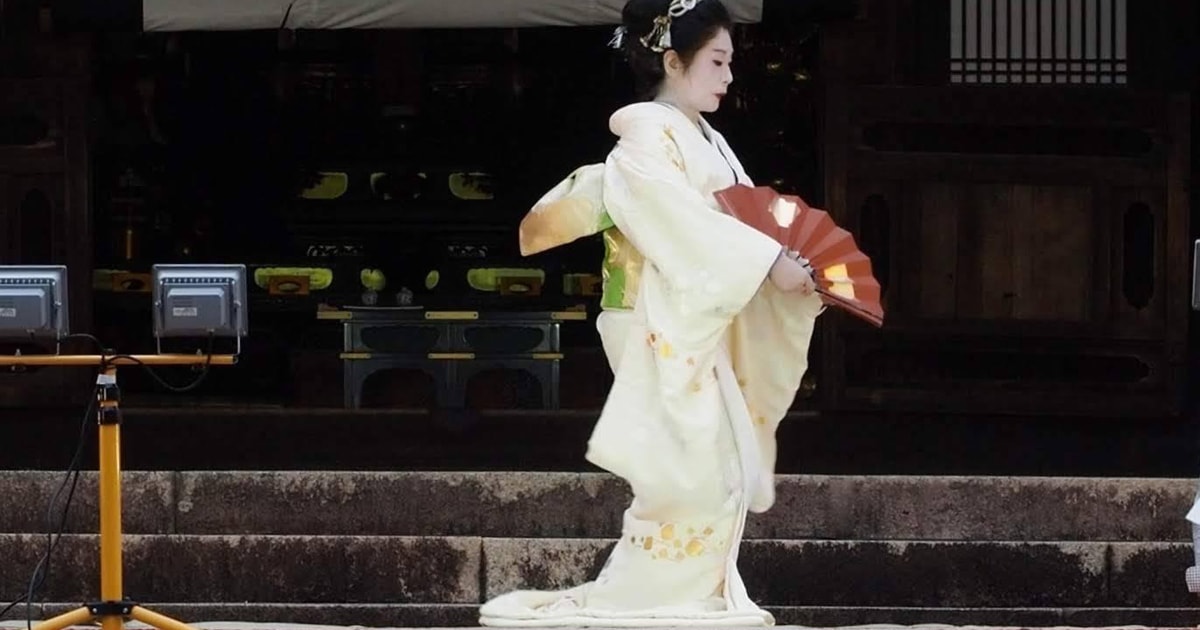
The short answer
Is the kabuki dance performance in Kyoto worth it?
Choose it if you want classical Japanese dance up close, in a temple, with someone explaining what you are watching. The booking page shows a perfect 5.0 from 17 reviews, but only 17 people have rated it so far, so treat the number as an early good sign and not a verdict. Go expecting a seated session with two or three dances, not a staged kabuki play with sets, a chorus and an interval.
Six points worth weighing
What kind of evening it is
The organiser is a Kyoto cultural exchange association, and the hour is built like a short lesson followed by a recital: tea and sweets, a spoken introduction to kabuki and to buyō, then the dances. That order helps a first-timer, because the movements make more sense once someone has explained how the fan is used to stand in for a cup, a letter or a falling petal.
A dance, not a full play
Kabuki in a big theatre runs for hours, with plots, many actors and elaborate sets. This session shows the dance side of the tradition, which began as kabuki dance and grew into its own genre. If a three-hour play in Japanese is what you came for, the city has a historic kabuki theatre; if you want a small room and a clear explanation, this is the better fit.
Small and seated
The booking page describes a small, seated gathering in a temple hall. Expect to sit for most of the session and to be asked to follow temple manners, including covered shoulders: sleeveless tops are not allowed. If you are asked to remove your shoes, socks are a good idea.
Reviews praise the English
Several reviewers pick out the clear English explanations, which is the part that decides whether a dance performance makes sense to a visitor who has never watched one. The sample is only 17 reviews, so the pattern is encouraging and not yet proven.
Booking and cancelling
The listing shows free cancellation plus a pay-later choice. Because the session is small, choose a date early rather than hoping for a place on the day.
Who it suits least
Anyone who wants a loud, spectacular show, anyone who cannot sit still on the floor or on a low seat for two hours, and anyone expecting costume-changes and swordplay. The attraction here is quiet precision, so it suits people who like to watch hands, fans and posture.
Seven things behind the fan
Seven things to know before the fan opens
The session is about dance, and dance has a history. Each card below condenses what Wikipedia, Kyoto Travel and a Kyoto theatre guide say, in plain words.
-
The beginning
A riverbed in Kyoto, around 1603
Wikipedia says kabuki is thought to have begun in the early 1600s, when Izumo no Okuni, once a shrine maiden, staged dance drama with an all-female troupe on a makeshift stage in the dry bed of the Kamo River in Kyoto. The earliest pieces were songs and dances with no real plot.
-
The change
Why the cast became all-male
Women were banned from kabuki in 1629 over public-order concerns, and young boys were later banned too, so adult men took over every role. Female roles are played by specialists called onnagata. Nihon-buyō itself, by contrast, is also danced by women, says Wikipedia.
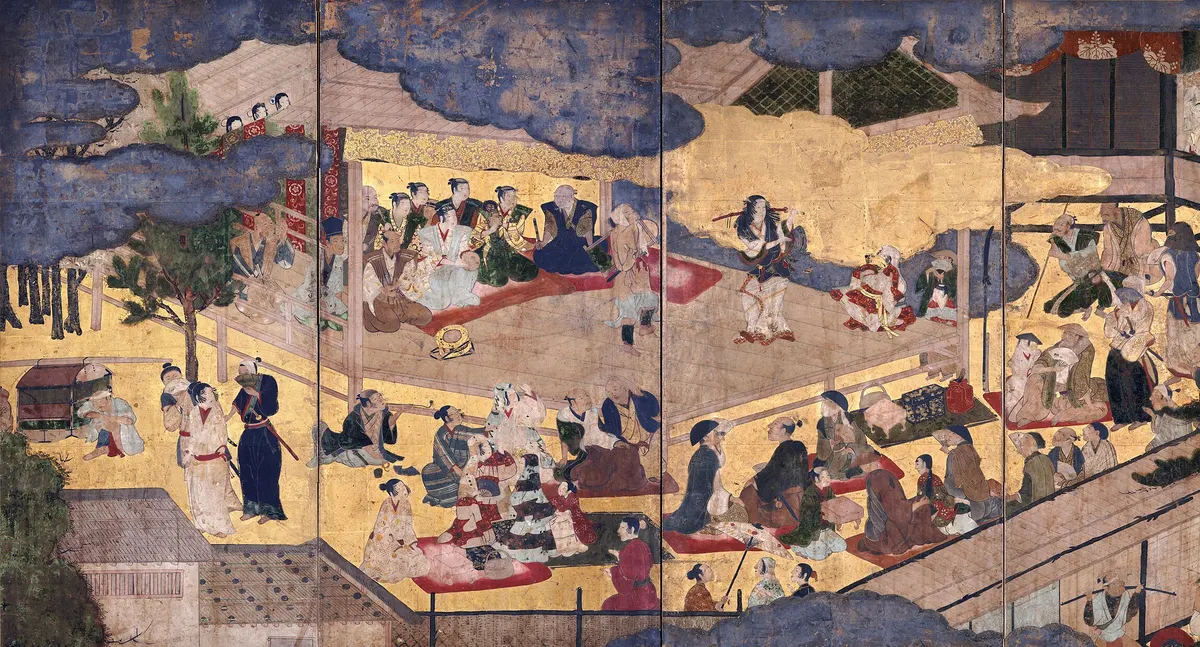
Early kabuki on a gold screen, Kyoto National Museum collection, around 1603. -
The offshoot
How dance became its own art
Wikipedia explains that nihon-buyō developed during the Edo period through kabuki dances, and that the word buyō was coined in the Meiji era. In the narrow sense it means kabuki-buyō, the dance pieces from the kabuki stage, which Japan has listed as an important intangible cultural property since 1955.
-
The vocabulary
Mai, odori and furi
Wikipedia names three elements: mai, a still and ritual style; odori, a lively rhythmic one that traces to a medieval Buddhist chant dance; and furi, mimed gestures drawn from everyday Edo-period life, like composing a letter or pouring a drink. A single dance can pass through all three.
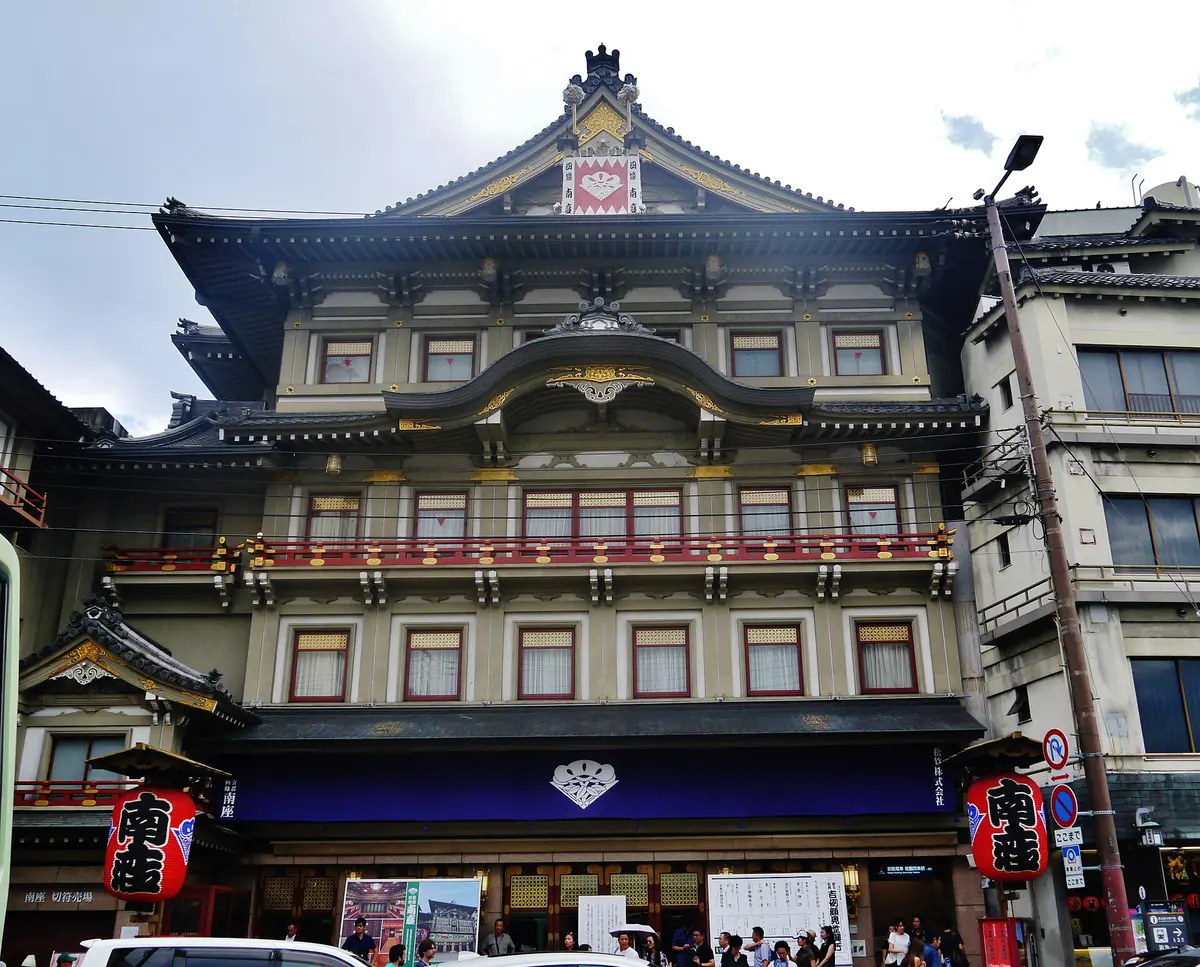
The Minami-za, Kyoto's kabuki theatre, on Shijō Street. -
The prop
The folding fan
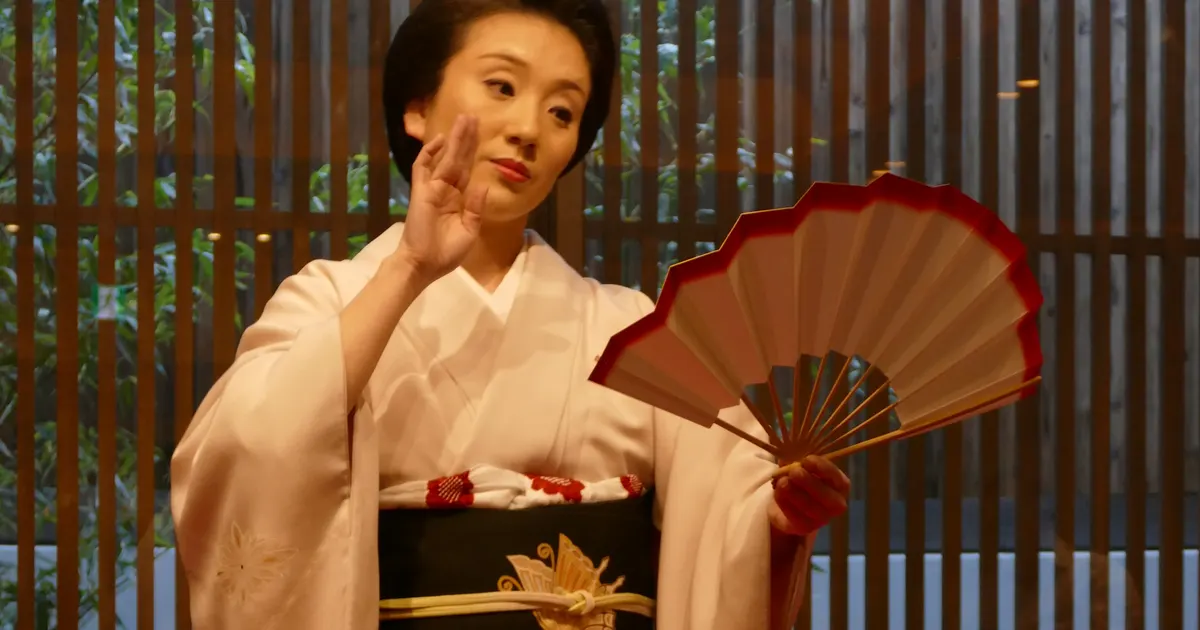
Kyoto Travel says a dancer conveys romance, seasons or legends through movement and a fan. Wikipedia adds that the folding fan was invented in Japan and that actors and dancers use it on stage; the dancing fan, the mai ogi, has ten sticks and a thick paper mount that carries a family crest.
-
The local flavour
Kyoto and Osaka had their own style
Wikipedia describes kamigata-mai, a quieter dance born in the Kyoto and Osaka region and performed in small rooms, sometimes on the space of a single tatami mat, with slow, gentle movement. Kabuki in the same region was also said to favour natural, realistic acting, against the flamboyant manner of Edo.
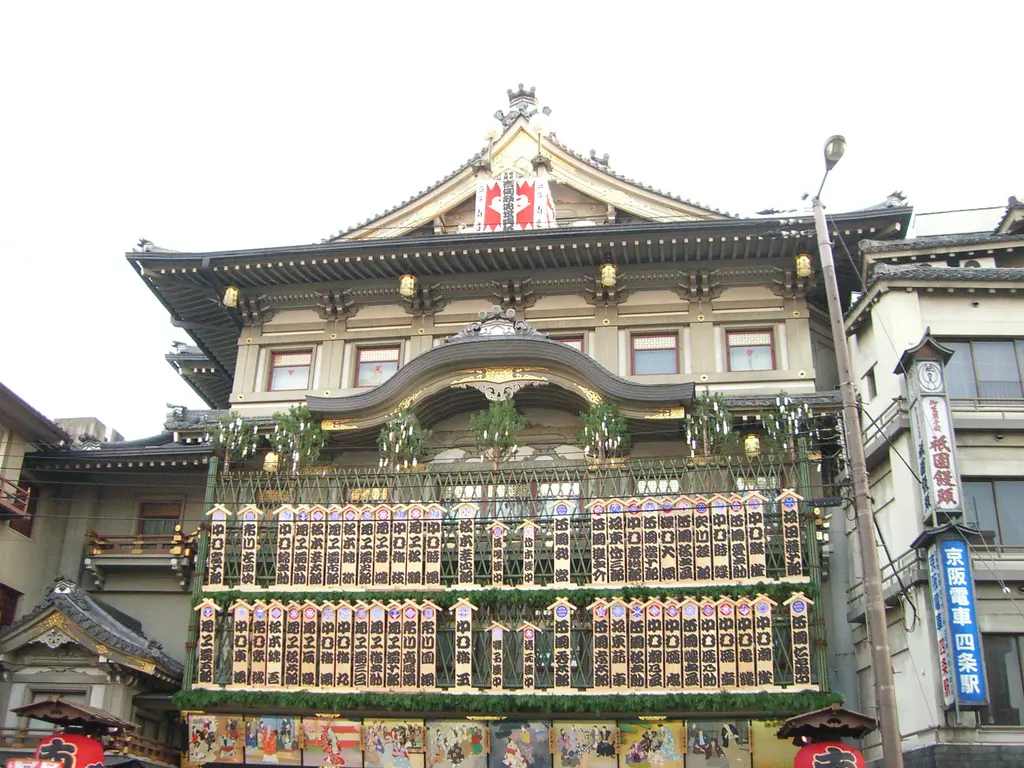
The Minami-za on the day of Kaomise, 2007. -
The recognition
A heritage-listed art
Kabuki was proclaimed by UNESCO as an intangible heritage of outstanding universal value in 2005 and then entered it on the Representative List in 2008. Kyoto Travel notes that Japanese dance has more than a hundred schools and welcomes beginners of every age.
Sources: English Wikipedia on Kabuki, Izumo no Okuni, Nihon-buyō, Minami-za and Hand fan; Kyoto Travel, the performing arts list; Inside Kyoto on the Minami-za; the booking page.
Four centuries of kabuki in Kyoto, by date
Kabuki in Kyoto in seven dates
- c. 1603
Izumo no Okuni performs on the dry Kamo riverbed at Shijō
Link to the temple hour: The dance-and-song form the session introduces begins here, per Wikipedia
- 1610
The Minami-za is founded as the Shijō Minami-za
Link to the temple hour: Kyoto's kabuki theatre, which Wikipedia says predates those of Tokyo and Osaka
- 1629
Women are banned from kabuki; men take over all roles
Link to the temple hour: The reason onnagata roles exist, per Wikipedia
- 1929
The present Minami-za building is completed
Link to the temple hour: A Momoyama-style home for kabuki, per Wikipedia, seating 1,086
- 1955
Kabuki-buyō is listed as an important intangible cultural property
Link to the temple hour: The dance branch the session shows, per Wikipedia
- 2002
A statue of Okuni is unveiled by the Kamo River
Link to the temple hour: Marks 400 years of kabuki, per Wikipedia
- 2005-2008
UNESCO proclaims, then inscribes, kabuki
Link to the temple hour: International recognition for the wider tradition, per Wikipedia
What the booking page lists
Reading the booking page closely
Taken from the booking page as it stood on 19 November 2026; anything the page does not mention is left unmentioned here as well.
Open the calendar ↗The cheapest fare spotted when this page was last updated. Your chosen date sets the figure you actually pay, shown in your currency before you commit.
- The organiser
- A Kyoto cultural exchange association, according to the booking page. The session is run by them, not by this guide.
- The setting
- Saisyu-ji Temple. The booking page puts it a 10 to 15 minute walk from Kyoto Station and from Gojo subway station.
- The first half
- Matcha and Japanese sweets, then an introduction to kabuki and to traditional Japanese dance, buyō.
- The dances
- Two or three dances by a professional dancer, showing fan work and storytelling through movement.
- The ending
- Photos with the dancer at the end of the session, says the booking page.
- What it does not say
- Nothing there names the dancer, lists the pieces or promises a fixed start time; those details and the meeting instructions arrive after you book.
Temple hall or Gion lanes
Kabuki dance in a temple or a Gion walk: which Kyoto evening?
Book the dance, then fill the rest of Kyoto
Other Kyoto bookings to set beside it
The temple hour takes up one afternoon or evening. Three other Kyoto bookings are set beside it below, each described only from its own title and summary.
- Check dates ↗
Kabuki dance performance with matcha at Saisyu-ji Temple
A two-hour session run by a Kyoto cultural exchange association: an introduction to kabuki and buyo, two or three dances by a professional dancer, and photos at the end.
- Check dates ↗
Gion hidden-gems culture walk
A two-hour guided walk through Gion, going by its summary: teahouse streets, temples and shrines. The natural rival for an evening in the old entertainment district.
- Check dates ↗
Kintsugi gold-repair workshop in Gion
A 45-minute hands-on session repairing ceramics with golden powder, going by its title. A short craft stop that pairs with a stage hour.
- Check dates ↗
Sake brewery tour with food pairing
A three-hour tasting and brewery visit, going by its title. A longer, more social outing than a seated dance session.
Also bookable in Kyoto
Settling the session
Four things to settle before the session
Choose your date
Open the calendar and pick the session that suits you. The e-mail you receive afterwards gives the date and meeting details.
Dress for a temple
Sleeveless tops are not allowed inside the temple, so bring a shirt with sleeves or a light layer. If you are asked to remove your shoes, socks help.
Plan the walk
The booking page puts the temple a 10 to 15 minute walk from Kyoto Station and from Gojo subway station. Allow extra time on the first visit and follow the meeting instructions in your confirmation.
Know what you are booking
This is a dance performance with a spoken introduction, not a full kabuki play. It is small and seated, so it suits anyone who likes to watch closely and does not suit anyone who wants spectacle.
The dancer, the theatre and the river
The dancer, the theatre and the river
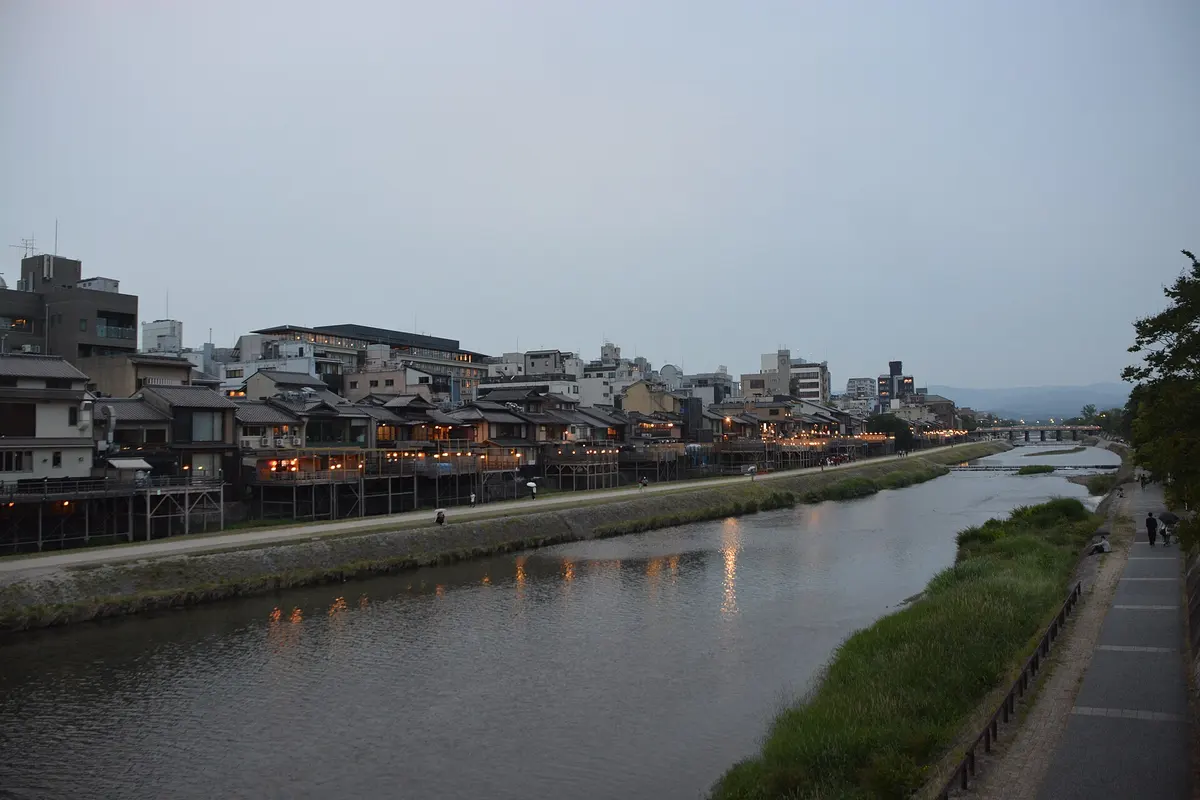
Photographs and a painted screen from Wikimedia Commons: a fan dancer, early kabuki, the Minami-za theatre and the Kamo at Shijō.
Six deeper reads
Six reads on kabuki dance in Kyoto
- Start here Is the kabuki dance performance in Kyoto worth it? how much weight a 5.0 from 17 reviews carries A two-hour temple session with matcha, a talk on kabuki and two or three dances, weighed up in plain terms: who it suits, who it does not and what to settle before booking. Read →
- The comparison Kabuki dance in a temple or a Gion walk: which Kyoto evening is better? A seated two-hour dance session and a two-hour walk through Gion look like rivals on a Kyoto itinerary. They answer different questions, and this guide sets out which one answers yours. Read →
- The origins Izumo no Okuni and the Kamo riverbank: where kabuki began A former shrine maiden, a dry riverbed in Kyoto and a troupe of women: the short and slightly uncertain story of how kabuki started, from Wikipedia and Kyoto sources. Read →
- The dance Buyō explained: the dance inside kabuki, and what to watch for What Japanese dance is, how it split from the kabuki stage, and the three kinds of movement worth watching for in a temple recital. Read →
- The fan The folding fan in Japanese dance: what the dancer does with it Where the folding fan comes from, how a dancing fan differs from an everyday one and why it carries so much of the storytelling in a short recital. Read →
- The theatre The Minami-za and seeing a full kabuki programme in Kyoto Kyoto's historic kabuki theatre, what makes its stage special and how a temple dance session differs from a night at the theatre. Read →
FAQ
Questions to settle before you pick a session
Is the kabuki dance performance in Kyoto worth it?
For most curious visitors, yes: the booking page shows 5.0 stars from 17 reviews, with reviewers praising the clear English explanations. It is a small sample, and the session is a seated dance recital, not a full kabuki play.
Is it a full kabuki play?
No. The booking page describes an introduction to kabuki and to traditional Japanese dance, then two or three dances by a professional dancer. A full kabuki play, with a story, sets and many actors, is a different and longer outing.
Where does it take place?
At Saisyu-ji Temple in Kyoto, a 10 to 15 minute walk from Kyoto Station and from Gojo subway station, according to the booking page. The e-mail you get after booking gives the meeting details.
Is it done in English?
Reviewers on the booking page praise clear English explanations, and the introduction to kabuki is part of the session. Dance itself needs no language.
What should I wear?
Sleeveless tops are not allowed in the temple, so wear sleeves or bring a layer. If you are asked to remove your shoes, socks are a good idea.
What is included?
Matcha and Japanese sweets, an introduction to kabuki and buyō, two or three dances by a professional dancer, and photos with the dancer at the end, according to the booking page. Anything not listed there should be treated as not included.
What about cancelling?
The booking page shows free cancellation plus a pay-later choice. The calendar and your confirmation show the exact terms for your date.
What is buyō?
Buyō means Japanese dance. In the narrow sense it is the dance pieces of the kabuki stage, and Kyoto Travel describes it as telling stories of romance, seasons or legends through movement and a fan.
Should I see this or walk around Gion?
They suit different moods. The temple session explains one art form and keeps you seated; a Gion walk shows an old district on foot. You can book both on separate evenings.
Can I see real kabuki in Kyoto too?
Yes: the Minami-za, Kyoto's historic kabuki theatre, stages kabuki, and its programme and tickets are listed by the theatre's operator. A dance session and a full performance answer different questions.