The origins
Izumo no Okuni and the Kamo riverbank: where kabuki began
A former shrine maiden, a dry riverbed in Kyoto and a troupe of women: the short and slightly uncertain story of how kabuki started, from Wikipedia and Kyoto sources.
Reserve a place ↗Quick answer
Kabuki is thought to have begun around 1603 in Kyoto, when Izumo no Okuni, a performer described as a former shrine maiden, danced with a troupe of women on the dry bed of the Kamo River at Shijō. Wikipedia stresses that few concrete details of her life are known, so the story is part history and part tradition. What is secure is the setting: Kyoto, the river and the early mix of song, dance and comic sketches that onlookers called kabuki.
Okuni and early kabuki in brief
| What Wikipedia says | |
|---|---|
| Who | Izumo no Okuni, a miko (shrine maiden) believed to have invented kabuki |
| Where | The dry bed of the Kamo River at Shijō in Kyoto, and at Kitano Shrine |
| When | Around 1603, with her retirement around 1610 |
| The troupe | Women, who played both male and female roles |
| The name | Several theories; one is kabukimono, people who dressed oddly and swaggered |
| The end of women's kabuki | A ban in 1629 by the shogun Tokugawa Iemitsu |
A woman from Izumo
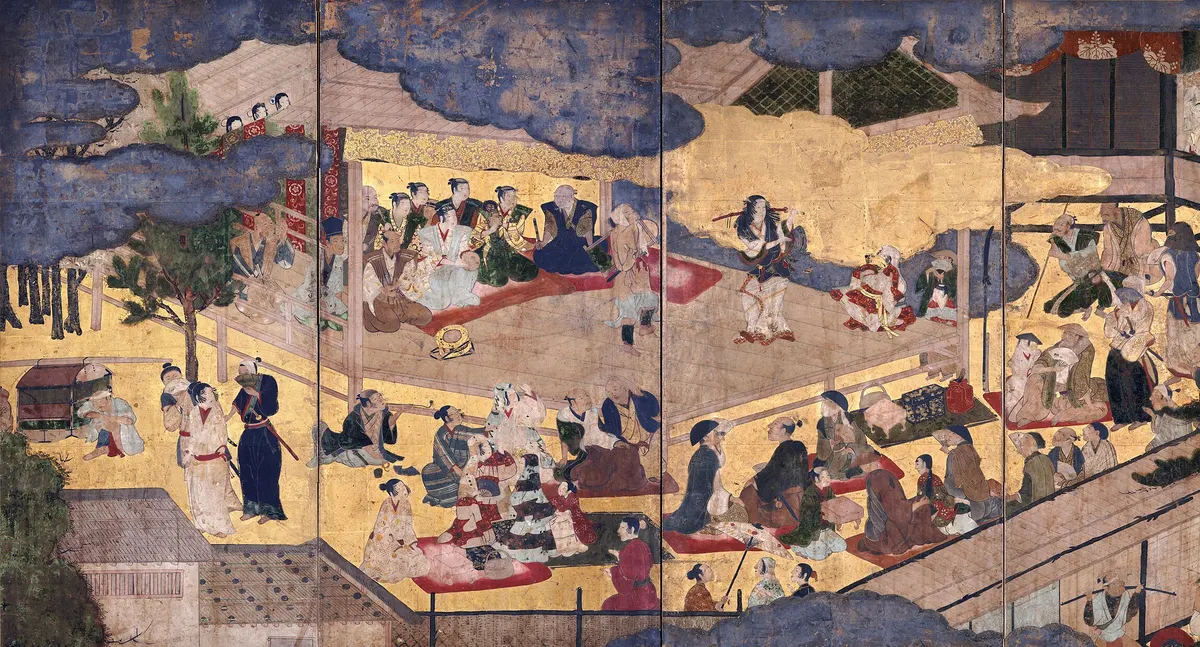
Wikipedia describes Okuni as a Japanese entertainer and miko who is believed to have invented kabuki. She is said to have been born near Izumo Province around 1578 and to have served at the Izumo Grand Shrine, where she became known for her dancing and acting. Shrine servants were sent to Kyoto to collect contributions, and she was sent there to perform sacred dances and songs. The account says she did not stay a shrine performer: she became known in the capital for a Buddhist chant-dance called nembutsu odori, which by her time had turned into a largely secular folk dance, and she was said to give it a witty, sometimes suggestive edge. The article is candid that the record is thin, and a careful reader should hold the biography loosely.
The stage on the river
The key image is a performer on a makeshift stage in the dry bed of the Kamo River. Wikipedia places the start of kabuki around 1603, on the Shijō riverbed, a wide, flat, public place where a crowd could gather without a theatre. She also performed at Kitano Shrine and, according to the same account, for ladies of the imperial court. The gold-leaf screen in the Kyoto National Museum collection, probably painted by an artist of the Hasegawa school and dated to about 1603, is the oldest known portrait of Okuni and shows a performance with musicians and a crowd. It is a rare picture from the beginning of the tradition.
What the first kabuki looked like
The earliest performances were song and dance without a real plot, and Wikipedia reports that critics found them overly sexual and noisy while others praised them as colourful and beautiful. Okuni's troupe was all women, so her performers played male roles as well as female ones. One of her most famous pieces featured the spirit of Nagoya Sansaburō, a real samurai who had died in 1603, drawn back to dance with her. The article adds that she is said to have introduced the forerunner of the hanamichi, the raised walkway that runs through the audience in kabuki theatres today.
Where the word comes from
Several theories exist, says Wikipedia. One traces kabuki to kabukimono, people who dressed oddly and swaggered through the streets, from the verb kabuku, to lean in a certain direction. Another points to katamuki, meaning slanted or strongly inclined. In either case onlookers applied the word to Okuni's troupe because of its eccentricity and social daring.
After Okuni
Okuni retired around 1610 and disappeared from the record; her death is given variously as 1610, 1613 or 1640. Her style was copied widely, including by brothels, and in 1629 the shogun Tokugawa Iemitsu banned women from performing in kabuki, citing calls for moral reform and fights over the actresses. Young men replaced them, a form that was also banned, and the tradition settled into the all-male format that Wikipedia says continues in established theatres today. Inside Kyoto adds that boys' troupes were banned in 1652.
Walking to the place today
The riverbank is still there. A statue of Okuni stands at the east end of Shijō Ōhashi, the bridge over the Kamo, diagonally across from the Minami-za, according to Wikipedia, and it was put up in November 2002 to mark 400 years of kabuki. Kyoto Travel also opens its performing arts page with the same origin story, a female entertainer called Okuni dancing in Kyoto in 1603. If you book the temple dance session described elsewhere on this site, the bridge and the statue make a good short walk for a different day.
What to hold lightly
Because so little is known for certain, treat dates and details as tradition. The year 1603 is a convention, her birth year is approximate and her end is disputed. What stands up well is the larger shape of the story: kabuki began as popular entertainment in Kyoto, led by a woman, before the state restricted it and men reshaped it. That shape is why a dance session in a Kyoto temple feels linked to the place, even though the dances you see have been refined over four centuries.
Frequently asked questions
Who was Izumo no Okuni?
A performer described by Wikipedia as a miko and entertainer who is believed to have invented kabuki.
Where did she perform?
On the dry bed of the Kamo River at Shijō in Kyoto and at Kitano Shrine, per Wikipedia.
Why are there no women in kabuki?
Women were banned from kabuki in 1629 by the shogun Tokugawa Iemitsu, and men took over all roles.
Is there a statue of her?
Yes, at the east end of Shijō Ōhashi in Kyoto, erected in 2002, according to Wikipedia.
Sources